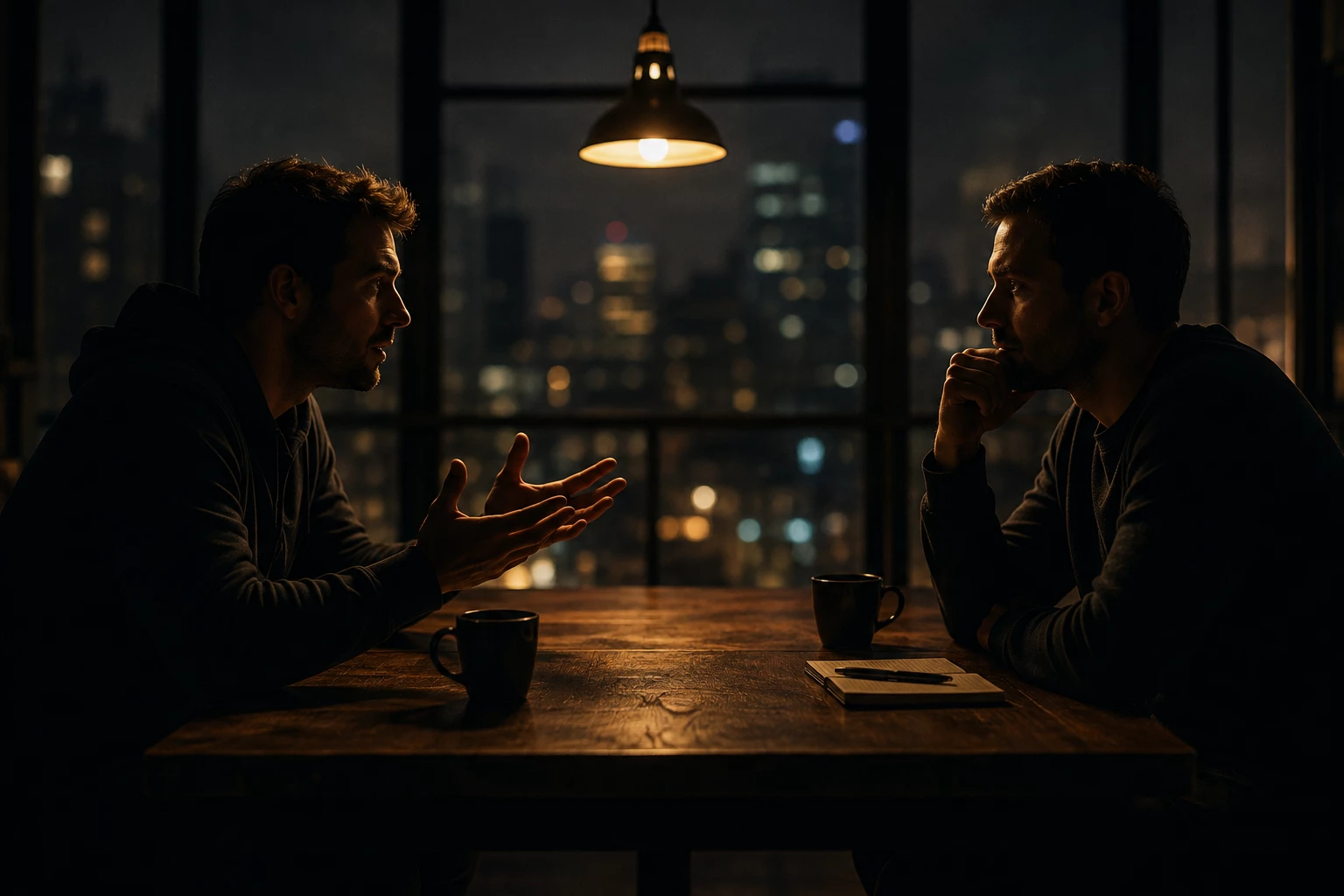
A conversation about responsibility, indifference, and civic stance. Where is the line between personal conscience and silence, and can indifference shape the future just as much as actions do?
Sometimes a single conversation makes you think harder than dozens of books you've read.That's exactly what happened this time too.
A friend and I were talking about humanity, responsibility, and where the line lies between personal conscience and collective responsibility. At first it was just an ordinary friendly chat. But it very quickly turned into a real discussion, in which each of us tried not just to state our opinion, but to understand the other.
The question wasn't easy.
Is a person responsible for the actions of their state if they personally don't support the wrongdoing, but also do nothing to stop it?
My friend believed the answer was no. If a person doesn't support violence, doesn't take part in it, and simply lives their own life, they can't be blamed.
I saw it differently.
In my view, there's a difference between someone who actively supports injustice and someone who stays silent. But silence has its own price too. If a person sees the wrong, understands its consequences, but consciously chooses complete indifference, they too, to some extent, take part in what's happening.
Of course, I'm not talking about reckless heroism or calls to sacrifice one's own family.
Every person has the right to protect their loved ones.
But between complete inaction and self-sacrifice, there's an enormous range of possibilities.
You can look for like-minded people.
You can support civic initiatives.
You can spread truthful information.
You can help those who are already working toward change.
You can take part in lawful civic processes.
You can speak up.
Because every great change starts with small steps.
It seems to me that today many people have grown used to living in informational comfort.
Work, home, TV shows, short videos, the news feed...
All of it creates an illusion of safety.
It seems that if you don't look at the problem, it won't touch you.
But history shows, again and again, the opposite.
What seems like someone else's problem today may arrive at your own door tomorrow.
That's exactly why what concerns me isn't only the question of war or politics.
What concerns me is the question of responsibility.
Are we ready to take part in the life of society?
Are we ready to at least stay interested in what's happening?
Are we ready to think not only about today, but about what we'll leave for our children and grandchildren?
Real politics doesn't begin in parliament.
It begins where a person stops being indifferent to their own future.
Today there are many civic associations, independent media outlets, educational projects, and initiatives trying to change life through peaceful and lawful means. Everyone can find what resonates with them, support it, or join in.
You don't have to be a leader.
You don't have to be well-known.
It's enough to simply stop being indifferent.
During our conversation, we never convinced each other.
Each of us stuck to our own opinion.
But that was exactly its value.
We listened.
We objected.
We made arguments.
We tried to understand.
And maybe conversations like this gradually change people far more than loud slogans ever could.
Because no society begins with power.
It begins with a person who, one day, asks themselves a simple question:
"What can I actually do?"
Discussion